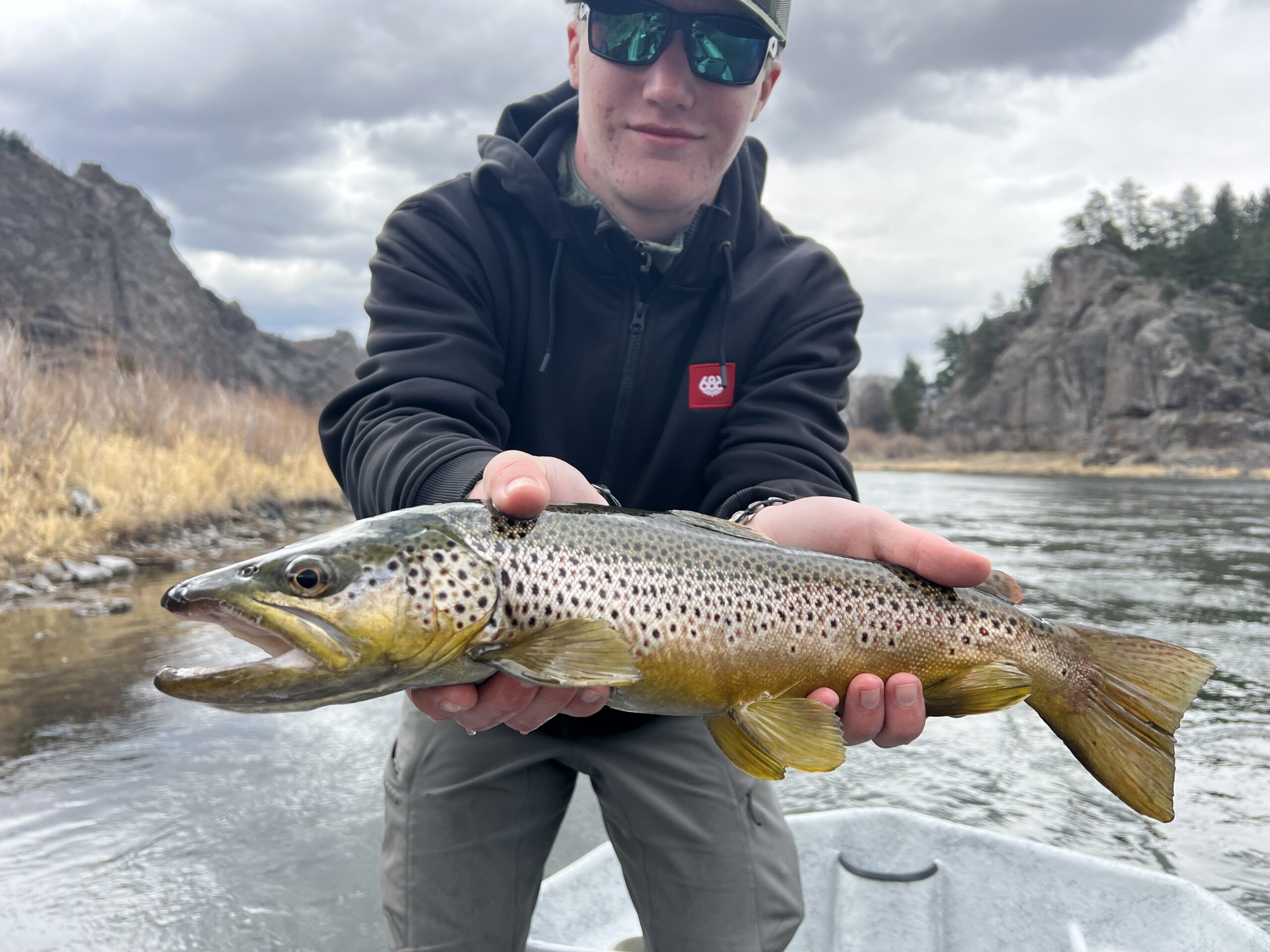
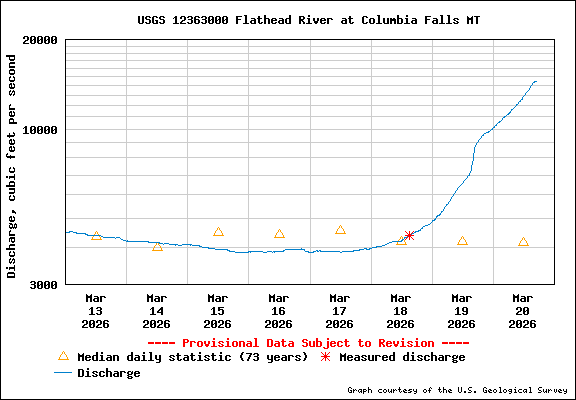
April has been quite the thrill with weather. After our freezing winter like beginning we had some summerish 80 degree weather last week followed by another dose of freezing weather this week. All of our western freestone rivers responded to the heat with a big push of water and the fishing was put off for a few days. The rivers have all dropped back into shape now and it’s back to business as usual, but we had to bail out to the Missouri for a couple days for better fishing. And better fishing it was.
This is nothing new. It seems like every April we have a push of water that will send us over to the Missouri for a few days. Lucky for us the Missouri isn’t too far and the fishing is usually good in the spring. The only problem is that once you take clients to the Mo and they see the size and quantity of fish you can put in the boat in a day, they never want to go anywhere else.
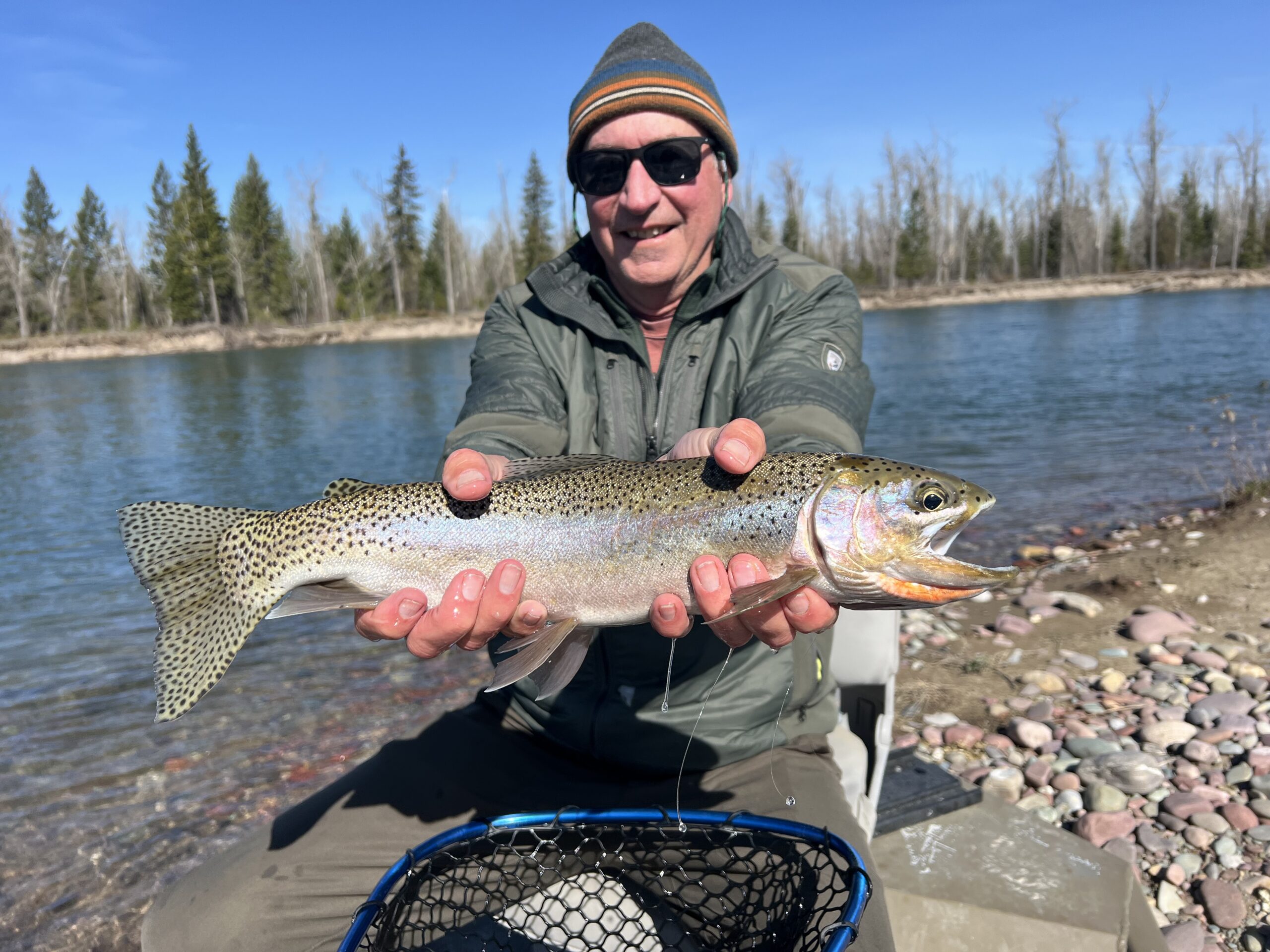
It was odd to see so many rainbows around. We caught a ton of nice bows so they are either done spawning and back to the river, or they have been spawning in river this year. Either way it seems like more than usual for this time of year.
I stayed an extra day and did a little streamer fishing on the lower river as well. We caught a few nice fish on streamers and found a few fish willing to eat March brown dry flies too. Sure nice to throw a size 12 parachute on the Mo.
I’ll be back in the shop this week putting away all the new bugs we just got in. We have some nice new hoppers, and foamies to check out. Also, we just picked up Ross reels so they should be here soon.
It seems that everybody uses March brown and grey drake interchangeably and for good reason, you can basically use the same patterns for either bug. But, we do have both bugs and if you want to know the difference it is pretty easy to figure out.
According to Hatch Magazine:
Who really cares…….a parachute whatever or cripple will work for both.
The Confederated Salish-Kootenai Tribes and Montana FWP are sponsoring three public meetings April 12-14 to gather ideas for an upcoming environmental review that will address how to reduce lake trout predation on bull and cutthroat trout in the Flathead Lake and River system.
What anglers should know about Flathead Lake, lake trout and native trout
In the last 20 years, populations of migratory native cutthroat and bull trout that use both Flathead Lake and essential connecting habitat in the Flathead River and its Middle and North Forks have plummeted. As a result, angling opportunities for bull trout has been completely curtailed for bull trout and severely reduced for cutthroats. Biologists conclude the primary reason for the precipitous drop in native trout is predation from an expanding population of non-native lake trout that occupies Flathead Lake. Lake trout numbers in the catchable range are now estimated to be about 400,000 in the lake. Subsequently, adult bull trout that use the lake and which migrate into the upper river now number only around 2,500 – 3,500 individuals, which is a small percentage of their historical average. In recognition of the problem, the 10-year co-operative plan guiding fishery management on the lake developed in 2000 by the Tribes and FWP sought to reduce lake trout numbers by employing recreational angling and fishing tourneys. Results from this plan, now in its 10th year, indicate not enough lake trout are being removed to speed recovery of bull and cutthroat trout populations.
And so the Tribes and FWP are evaluating the potential for additional measures for lake trout removal, including a carefully designed pilot project involving gillnetting. The intention is to reduce the lake trout population further – perhaps by 25 percent or thereabouts — providing an edge for bull and cutthroat trout to increase their numbers, while not eliminating angling for lake trout.
The Tribes and State want to know what you think and are holding scoping meetings on proposals to increase the removal of lake trout. Meetings will be:
- April 12 in Polson at the Kwa Taq Nuk Resort 7-9 pm.
- April 13 in Kalispell at the Red Lion Inn (20 North Main), 7-9:30 p.m.
- April 14 in Missoula at the Wingate Inn (5252 Airway Drive) 7:30 to 9:30
What you can do - Attend one of the meetings or submit written comments and tell the Tribes and State in your own words:
- The objective for bull trout and cutthroat trout recovery in the Flathead Lake and River system should be population numbers similar to what they were in the 1980s, before bull trout dwindled to levels necessitating prohibiting angling for them and their listing as a threatened species
- The environmental study on additional lake trout removal should include a preferred alternative that supplements angling with effective measures such as gillnetting and trapping.
- The environmental study should include an evaluation of how its proposed action will benefit the river system above the lake, including the important recreational and outfitted angling that occurs there for both species of native trout.
- Any personal experience you have with fishing for Montana’s native trout, especially in the Flathead region.
THIS IS CRITICAL: Submit your comments in the next two weeks to:
Barry Hansen
project chief Confederated Salish and Kootenai Tribes
Box 278 Pablo, MT 59855
barryh@cskt.org
and
Bruce Rich,
fishery bureau chief
Montana FWP
1420 East 6th Avenue
Helena, MT 59620
brich@mt.gov
We have had some crazy weather the last week. Now that we’ve had our April weather in March, I guess we need to have some March weather in April. We had trips out all week and despite the snow, 40 mph wind, hail, and freezing temps the fish still wanted to eat the dry fly for at least a few hours in the day if not all day.
I have been on the Bitterroot River mostly and we got into some great hatches and nice fish. Not that the Bitterroot needs anymore press but it really is amazing how well the river will fish with the dry fly even in the worst weather conditions spring has to offer.
I had some good anglers and that really makes a difference this time of year too. The water is VERY low and the fish are not easy, so the ability to get your fly downstream with a drag free drift really helps. The weather has been pretty intense and I give props to our anglers for sticking it out. It paid off in the end.
It looks like the weather is going to mellow a bit and we should get another round of skwalas. Look for great fishing through the rest of spring.
This has been talked about many times but it never hurts to revisit this issue. The skwala season is here and with it will come crowds. There are a handful of basic rules of the river that if everyone followed would allow us all to get along and enjoy our fishing. First one is boat prep. It would seem obvious that you should prep your boat and gear off to the side of the ramp out of the way of other vehicles trying to pass by or get to the ramp themselves. There are people out there that like to prep there boat on the ramp and spread all their gear out like a yard sale taking up the launch for 20 minutes. Once you get your boat in the water, move it away from the ramp so others have room to launch. Once the boat is in, park your car in an area that allows others to maneuver in and out of the ramp. All these rules apply on your way out of the water as well. Pull your boat out away from the ramp and gear down after.
River etiquette is also important. Pay attention to bank fisherman. If you are in a boat and can avoid the area they are fishing, then do so. If not, reel up and push by. Check your rear view mirror. If you have someone tailgating you then pull over and let them pass. If you are making an effort to pass another boat DO NOT pull in front and start fishing right after you make your pass. On small rivers it is a good rule to make sure the other boat is completely out of site before fishing again. On big rivers give them plenty of space and hit the other side but don’t pull in on the same bank they are fishing right after you make a pass. Another one of my favorite moves people make is what we call the rubber neck. This one mostly applies to smaller rivers. When you see a boat anchored downstream and the people are turning around watching (rubber necking) you approach, then right before you get there they pull anchor and push out in front of you. Don’t be that guy, let them pass. If you have some pet peeves, let us know so we can add them.